For North America’s driest peninsula, El Niño is more than a marine climate signal. In prior iterations, the warming of the tropical Pacific has brought significant rainfall to much of Baja California. These events briefly transform how water moves through the landscape. When storms activate normally dry arroyos, they connect mountain catchments, springs, pools, desert lowlands, wetlands, and the coast. These short-lived connections can recharge soils and aquifers, move nutrients and organisms, trigger recruitment and dispersal, and reveal species that remain undetectable through long dry intervals. The 2026–2027 El Niño event by all measurements and predictions will be the strongest yet recorded.
A coordinated scientific El Niño response offers a rare chance to document ecological change while it is happening. This will allow researchers to establish sites that can be revisited in subsequent wet and dry cycles, in a future likely to be driven by elevated temperatures and extreme pulses.
The 2027 Deconstructed El Niño Expeditions will combine one focused main expedition to the Sierra Guadalupe with small satellite expeditions distributed across poorly studied parts of the Baja California peninsula. Together they will capture a climatic event at multiple scales without the logistical burden of one oversized team, allowing for increased breadth and participation.
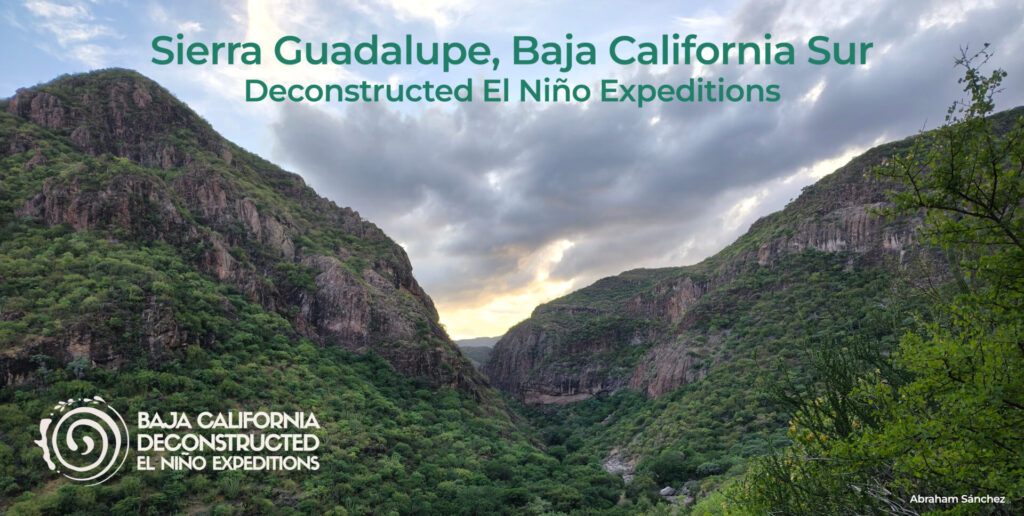
The main expedition of the Deconstructed El Niño Expeditions is a week-long exploration of the Sierra Guadalupe in Baja California Sur, comprising two travel days and five days of fieldwork. Tentative dates are January 10–16, 2027. Building on the rainfall brought to the region by recent hurricanes, the expedition will investigate how El Niño precipitation events shape the ecology and biodiversity of the Sierra Guadalupe. This week of research will have a particular emphasis on hydrological connectivity: how water moves through the landscape, linking habitats, ecosystems, and communities.
The expedition brings together a diverse transdisciplinary team of researchers and community members to explore the environmental consequences of El Niño-related rainfall pulses from multiple perspectives. By combining scientific observation, creative practice, documentation, and local knowledge, participants will contribute to a deeper understanding of the Sierra’s biodiversity, ecological processes, responses to extreme weather, and the beauty and complexity of its interconnected landscapes.
We currently have six places available for additional members of the N-Gen network.
Applications are now closed (deadline was 26 October 2026)